2016年4月18日 星期一

Switzerland: Newspaper Entries

Half a million Swiss bees wiped out
     On Aril 3rd, beekeepers from Lavey in the canton of Vaud, found that around 30,000 to 40,000 of the bees in their hives had died. Alois and Judith Wiggen, the beekeepers, said: "Inside the hives was a layer of dead bees ten centimeters deep." After some inspection, it was suspected that the bees had been poisoned. While some may think that they might have died to an illness, it had been confirmed by Alois and Judith Wiggen that "our bees had pollen on their feet which indicates they were in good health." Also, the two mentioned that the same thing had happened two years prior, and that they are currently trying to think of someone who would have a grudge against them; someone who would commit a crime like that.
Mystery killer wipes out half a million Swiss bees
image source: Eric Feferberg/AFP

Number of asylum seekers drop by 45%
     In the first quarter of 2016, it was said by the Swiss federal migration office (SEM) that 8,315 asylum requests were turned in. That equals to 45% less than the requests received in the last quarter of 2015. Throughout the entire of 2015, figures showed that Switzerland had received a total of 39,523 asylum requests. "The migration context is still very volatile and therefore unpredictable," SEM said. Although completely and accurately predicting the number of asylum seekers is not possible, SEM announces that it is quite likely for the number to rise within the course of the year.

Booksellers in Switzerland face problem of high postage costs
     Publishing houses in Switzerland are currently facing some difficulties due to the high postage costs. It takes at least seven francs to send a package economy post within the country, and nine francs to send a priority post. The postage cost for a book that costs 29 francs would reach up to 25 percent. "That's around twice as much as the author gets," says Wendelin Hess, director of Basel publishing house. A solution that has been thought of is for the federal government to pay for part of the taxes, like it does for newspapers, but for now, that is still an eventuality.

Switzerland: Post Card

Jed D' Eau
image source: makemytrip


Dear Aili,

I'm in Geneva, Switzerland right now with Kelly, and this would be our last destination before we come back. This is a picture of the Jed D' Eau, which translates into 'water jet' from French. The reason for the French name is because Switzerland neighbors countries like France, Germany, and Italy, so it absorbs a lot of the nearby cultures. This fountain is one of the tallest in the world, and 500 liters of water can be pumped to a maximum height of 140 meters. Amazing, right? The speed can also be up to 200 km/h! You could also see a rainbow in the daylight sometimes, and when we went there, some water splashed onto us because of the sudden change of wind.

The structure was originally built in 1886, and it was used to control and release excess pressure from La Coulouvreniere, a hydroelectricity plant. But later on it became a landmark of the city, and was moved to the middle of the lake. According to a brochure we took today, it said that the fountain is the "symbol of strength, ambition, and vitality of Geneva and Switzerland". It really is though, I really wish you were there to see it with us!

Love,

Annie (and Kelly) 


Switzerland: Journal Entries


Outside of La Muse
image source: timeout
Kelly and I haven't done much shopping due to the rather rushed schedule, so we decided to go shopping in our final destination, Geneva, Swizerland! People in Switzerland dress casually, but I did realized that people dress more nicely in bigger cities, like Geneva and Zurich. Black and darker fabrics are considered to be more stylish, and I heard this from my friend, 'when in doubt, wear black' (she said it's the same in France too). Swiss fashion designers are less recognized internationally, but there are still some amazing local designers. There are also a lot of high-end brands and those ever so famous Swiss watches. We stumbled upon this boutique called La Muse, and it really caught my attention. It has a mix of edgy brands by both local and international designers. Kelly found a dress she really liked, and I saw tons of shoes and jewelry that I adored. Unfortunately I only bought a few since it was quite expensive. We went to a lot of different stores after that, and used up all our budget for shopping. As we walked back to the hotel, our arms were full with bags and bags of clothes.

Before we came to Switzerland, I contacted a friend who used to live here to tell us about famous attractions and shops. Along with those information, she also mentioned her life and the values here. She said that people valued a strong sense of responsibility and hard work, along with material possessions. Also, you wouldn't really see strangers talking to each other in public spaces. She described Switzerland as clean, and I thought the photos of glaciers and lakes really added to the image. She also said that her sense of community was strong. Religion and family are also important in her life. Furthermore, due to the fact that there are multiple main languages spoken here, you could see different language speaking regions hold different kinds of habits and values.

We wanted to see if we happen to meet any of its public holidays, but unfortunately, none of its holidays are on April 18th. So we ended up just doing a lot of research on holidays instead. Some of its holidays are familiar, such as the New Year, Easter, Labor Day, and Christmas. But there are also a lot of Christian holidays that aren't as familiar. The Good Friday, for example, is celebrated on March 25th this year, and it's the Friday before Easter. There is also the Epiphany, or Three King's Day, celebrating the revelation of God in his son, Jesus, on January 6th. Also the Whit Monday, as known as Monday of the Holy Spirit, is the day after the Pentacost (celebration of the descent of Holy Spirit upon the disciples of Jesus), and its date is dependent on the date of Easter. There are also other various public holidays from Christianity, such as the All Saints, Assumption, and Corpus Christi. In addition, there is also the Swiss National Day, on August 8th, which celebrates Switzerland's national holiday. All the holidays mentioned above are public holidays, in which people get a day off. But there are also holidays like Valentines Day, Mothers Day, and Halloween, that are celebrated but not considered as 'public holidays'.

2016年4月14日 星期四

San Marino: Newspaper Entries

Declaration of the Ministers of the Council of Europe
The 25th session of the Council of Europe Standing Conference of Ministers of Education ended in April 12, with the theme of "securing education with democracy". It was held in Brussels, Belgium, and all of the countries have emphasized the need for strengthening a democratic citizenship throughout one's life. Also, it was needed to prevent violent extremism. The council developed a Reference Framework of Competences for Democratic Culture, which is needed for a city to participate in democratic citizenship paths. Although it is a hard task for schools, it is still crucial in future paths. San Marino's secretary of state, Giuseppe Maria Morganti said at the conference, "For this reason the worlds of education and training must reflect on the skills and knowledge necessary for citizens and towns, so that they can continue to be leaders, able to build their own life project."

Council members in the conference
image source: coe
How's the real estate market in San Marino? 
The most requested areas in the real estate market are the castle of Borgo Maggiore, Domagnano and Serravalle, and Heritage, which covers the historic center of San Marino. The Tecnocasa Group, a real estate company founded in 2002, has many agencies around San Marino, Italy, Spain, and other countries. According to Luca Chezzi, Tecnocasa's representative, the real estate market in San Marino mainly offers apartments and townhouses. There is little supply of independent houses, since most of the housing demand are from young families or couples. Young families have budgets around 80,000 to 250,000 euros, in contrast to entrepreneurs, who has a budget of more than 300,000 euros to invest. However, independent houses have a larger market because of its higher price.

The castle of Borgo Maggiore
image source: italia
General Capolupo reveals the details about the "Ivory Tower"
The general commander of Guardia di Finanaza (Italy's law enforcement agency), Saverio Calpolupo talked about San Marino in a taxation conference in Rome lately. He provided great detail about the transactions of the "Ivory Tower" that were not made public before, and hoped collaboration between the two countries. The "Ivory Tower" is referring to the thousands of people who had made large financial transfers with the Republic of San Marino, during the time period of 2004 to 2014. Which some are potentially evading taxation. General Calpolupo concluded, "At the end of the first phase of analysis and data processing, there were several thousand identified for significant risk profiles, for which the Departments of the Financial Police have initiated further investigation."

General Calpolupo
image source: sanmarinonotizie


San Marino: Post Card

Dogana, San Marino
image source: giornalesm.com
Hi Sally,
     It's your little sister again! This time, though, I'm writing to you from San Marino. I bought this postcard at a small stall in Dogana, a town in the north-eastern part of San Marino. It's not just any town though, it's the most populated settlement in San Marino! It has a population of around seven thousand, and was so big that it was asked to split away from Serravalle to become another castello in 2006. The proposal was rejected though, so that didn't happen. Also, did you know (and I know you didn't) that the word Dogana means 'customs house' in Italian?
     By the way, you probably didn't have much interest in the last post card I sent to you, but you would definitely find this place interesting, since there are quite a few shopping malls you can stop by. Annie and I went to this shopping mall called Atlante Shopping Center, which had tons of shops I think you would like to go to. 
                                                                                                        From Kelly (and Annie)

San Marino: Journal Entries


Arancini
image source: recipeshubs
     The first thing Annie and I did when we got to San Marino was head towards the first restaurant we saw, which happened to be a place called San Marino: Ristorante Italiano (I searched it up; apparently, ristorante means an Italian restaurant). I ordered some arancini, which are stuffed rice balls coated in breadcrumbs that are then fried. The one I ate had prosciutto, an Italian dry-cured ham, spinach, and fontina, a type of cheese, inside. It tasted delicious! Annie ordered something called Angel Hair Puttanesca, which turns out to be a famous Italian pasta dish. The waiter, when he served it to us, told us the dish was invented in the mid-20th century and included the ingredients typically used in Southern Italian cuisine: tomatoes, olives, olive oil, anchovies, capers, and garlic. I stole a bit of it from Annie, and found that it was quite delicious as well! Satisfied, we went to the hotel so we could leave our luggage, and start our excursion around San Marino properly.
Puttanesca
image source: barilla.com

     Something that impressed me deeply as Annie and I toured San Marino was the language people around us spoke; Italian. Italian originated from Latin, and was created when the Roman Empire fell in 476 AD, and Latin became a language that only the intellectual class knew fluently, while the rest of the population only used it for daily needs. For this reason, several languages were born: Spanish, French, Romansh, Romanian, and lastly, Italian. Even though I didn't hear a lot of it, another language used in San Marino is Emiliano-Romagnolo. It's a language that is sometimes spoken here because San Marino borders on Emilia-Romagna, the place where Emiliano-Romagnolo is spoken the most. I think both languages sound beautiful.

     Before the day ended, we checked out Dogana, a town in the north-eastern part of San Marino, and Palazzo Pubblico, the town hall and Official Government building of the City of San Marino. The government of San Marino is quite interesting. It has a representative democratic system going on, which means that they elect officials who represent a group of people. Originally, San Marino was led by a family called Arengo, then in the 13th century, power was handed over to the Great and General Council. In 1243, the first two Captains Regent were nominated. The Captains Regent are two heads of San Marino, and is re-elected every six months by the Great and General Council, usually from opposing parties. Politics is quite hard to understand, isn't it? Well, I'm going to write a postcard to my sister now, so she won't miss me that much. Ah, I also have to back up my things since Annie and I will start heading to Switzerland tomorrow.
Current Captains Regent (Lorella Stefanelli and Nicola Renzi
meets ambassador Laurence Argimon-Pistre
image source: eeas.europa.eu

2016年4月11日 星期一

Ukraine: Journal Entries


Chernivtsi Universy
image source: heritage.org

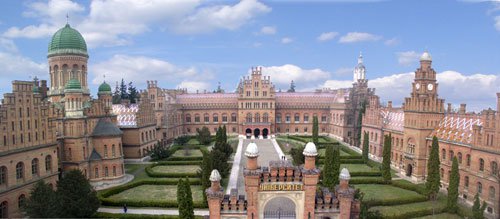
      Today, Annie and I arrived at our second destination- Ukraine. We left Norway after lunch and took the plane here, which took around two hours. The first thing I proposed we do was to go visit Chernivtsi University, a public university in Western Ukraine, since I've read that it's one of the 'leading Ukrainian institutions for higher education', which I thought seemed interesting. Another major reason was that it was listed by UNESCO, or the United Nations Educational, Scientific and Cultural Organization, an agency of the UN that sponsors special programs to promote education, science, and many more. Anyways, after we arrived at the Chernivtsi International Airport, we walked to the city center then took a trolleybus 1.5 km northwest to Chernivtsi University. The structure of the university, as expected, was amazing. Compiled mostly of red and grayish blue bricks, the wings of the university stood magnificently around a huge courtyard; I almost thought it was a castle when I first saw it. A lot of people tried to talk to us when we were exploring the insides of the university but we couldn't understand a thing they were saying, so we left after another few hours or so for our next site- the National Art Museum of Ukraine.

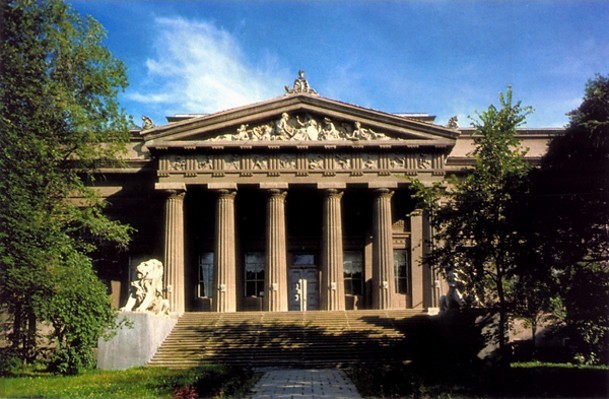
     I was quite skeptical about it, actually, since the National Art Museum of Ukraine was in Kiev, which was almost thirteen hours away from Chernivtsi by train. Thirteen, could you believe it? However, Annie insisted that she had to go there no matter what, so we ended up spending thirteen hours of our precious time in Ukraine on the train. (And I thought spending two hours on the plane without television was bad.) On the way there, Annie showed me a brochure of the museum which, luckily, was in English. Founded in 1996, the museum used to be called the City Museum of Antiques and Art, and it was only until 1994 did the museum reach an international level. I don't really know how to describe it, but the exterior of the museum gave off a kind of ancient artistic kind of feeling. Well, you can just see it for yourself:
National Art Museum of Ukraine
image source: encyclopediaofukraine
Doesn't it look amazing? Of course, the outside wasn't the only part that looked amazing- the inside was stunning too. There were many different types of art by many different artists; the only thing in common was that they all looked absolutely astonishing. Well, I'm not sure if it was worth the long train ride, but it certainly did make me feel a lot better.

Andreevsky Church at night
image source: visitkievukraine.com
     Annie and I actually planned to visit some orthodox churches which are apparently quite famous in Ukraine, but we ended up not having enough time to do so, which was quite disappointing. However, I managed to find a brochure at the National Art Museum that introduced me to orthodox churches a bit more. It was a brochure of the Andreevsky Church in Kiev, and it had lot of interesting facts and details about both the church and the religion practiced. Orthodox Christianity was accepted then widely spread in Europe by Prince Vladimir the Great in 988 A.D, and it is the religion that around seventy percent of Ukrainians practice today. One of the major accomplishments were that they translated the sacred writings in the Bible into Slavonic so that more people could actually read and understand it. The brochure also provided many pictures which just made me want to visit more, but oh well. We'll be heading to San Marino in a few hours, so there's no time to spare.

Ukraine: Post Card

Hey Sally,
     Your favorite (and only) little sister here. I'm in Kiev, Ukraine right now with my friend, Annie. I didn't want to come at first, since we had to ride the train for a really long time to get here, but here I am: at the National Art Museum of Ukraine. It's a museum with a lot of history. Founded in 1936, then soon split into two (a history section and an arts section; this is the latter, obviously), renamed Kyiv Museum of Ukrainian Art in 1953, reached the level of a 'national museum', renamed again in 1994 to what it's called today, and finally, the exhibition area was doubled in 1972. Interesting, right?
     It's split into three sections: old Ukrainian art, 19th and early 20th century Ukrainian art, and 20th century Ukrainian art, and is still like this today. The painting on this postcard is called Kyiv Museum of Ukrainian Art (the name this museum had in 1953) and it's by Ivan Izhakevych, a popular artist in Ukraine who studied art from three different schools. You don't care much for art, but I'm sure you would've liked to visit this museum with us. Well, probably. 
                                                                                                                       From Kelly (and Annie)


Image -- Ivan Izhakevych: Kyiv State Museum of Ukrainian Art (1932).
Kyiv State Museum of Ukrainian Art
image source: encyclopediaofukraine.com


Ukraine: Newspaper Entries

Ukraine's prime minister resigns
Arseniy Yatsenyuk announced his resignation as Ukrainian prime minister on Sunday, April 10th. He said he would later submit formally to the parliament on Tuesday. Mr. Yatsenyuk came into office promising to solve issues of corruption and to instill economic reforms, but recently he has been accused of corruption, even though there are no concrete evidence. His promises about economic reforms are also being questioned due to accused inactivity. However, the current president, Petro Poroshenko, has already asked him to quit in early Feburary, saying that he had lost his support. In addition, his party's approval rates have dropped to 2% according to recent opinion polls. But, Mr. Yatsenyuk said that the president's party have nominated the speaker of the parliament, Volodmyr Groysman, to fill his position.

Arseniy Yatsenyuk
image source: theguardian

Netherlands rejects EU-Ukraine partnership deal
Voters in the Netherlands rejected a European Union deal to remove trade barriers with Ukraine. It was triggered by an online petition by Eurosceptics, and it invited more than 400,000 signatures, which later resulted in a referendum. The turnout were at 32.2 percent, and it is considered valid if it passes the threshold of 30 percent. The votes in the Netherlands are widely seen as a test of public opinion regarding the EU. However, most 'No' campaigners are said to be unconcerned about the details of the trade, and some see it as a test of public opinion regarding the EU. But nearly two-thirds of people who were able to vote did not participate, so this does not show all the population's position on the issue. Lastly, Ukrainian president Petro Poroshenko insisted that the result will, "not be a strategic obstacle for Ukraine on the path to Europe". Also, Dmytro Kuleba, a Ukrainian senior foreign ministry officer, said, "Dutch Eurosceptics cannot take Ukraine as hostage to express dissatisfaction about the EU".

Ukraine's desperate attempt to defuse landmines - as more are planted

Ukraine's crisis of defusing landmines in its war-torn east have been proving to be more imperative every day, since former refugees are reclaiming their homes and coming back to work. The country banned landmines in 1997. Despite of that, Russian rebels and its own armed forces have been putting landmines in an estimated 74,000 acres of land. Landmines and unexploded ordnance (UXO) have killed more than 600 soldiers and civilians, and wounded more than 2,000 during the two years of war. Zeljko Lezaja, a land mine expert with the International committee of the Red Cross said, "Mines don't recognize ceasefires, they don't recognize friends or enemies. It costs $3 to produce a mine, but about $1,000 to clear one."

The wreckage of a minibus that hit a land mine in February,  killing four civilians
image source: theguardian


2016年4月7日 星期四

Norway: Post Card

A sculpture by Gustav Vigeland
image source: visitnorway
Dear Aili,

I'm in Oslo, Norway with my friend Kelly! It's a truly fabulous place here, the scenery is like no other places I've been to. We went to this sculpture park in Frognerparken, Oslo today, and it was filled with the life work of Gustav Vigeland (1869-1943), a Norwegian sculptor. The park was dotted with 200 life-sized sculptures made from bronze, granite, cast iron (iron-carbon alloys), and others. Isn't that amazing? This is also the world's largest sculpture park done by a single artist. We almost got lost because it was so huge!

You could see sculptures of men, women, and children. Some of them even interacting with each other, and each of them having their own unique stories. Although we were too tired to walk through the whole park, we still got to experience most of the park, and it was just a breathtaking and inspiring experience. Also, this is a really popular destination in Norway, and more than a million people come here to see it every year! I'm glad that we got to see it, but I wish you were here with us too!

P.S. This is my favorite sculpture in the park.

Love,

Your sister and her friend, Kelly

Norway: Journal Entries

Kelly and I went to Oslo, Norway's capital, today; the flight took around 15 hours from Taipei. The architecture here is so modern, yet, you can still see medieval churches and places that show history. I noticed that there are a lot of buildings made of plain wood, stone, and even sustainable materials!

Opera House (Oslo)
image source: visitnorway
The Opera House in Oslo built in 2008 is stunning, the design is also really clever since you can walk on the roof. However, we didn't have time to catch a performance today, but we did go to this stave church (stave architecture is a type of wood construction in Medieval times) in Lom the other day. This church is believed to date back to 1192 and it just looks absolutely gorgeous. The inside is also covered with wood, and it is currently used for weddings and church services. See for yourself!

Lomen stave church
image source: cookingintongues
Interior of Lomen stave church
image source: cookingintongues
Norway is a quite prosperous country, but I did hear that their taxes are really high. In contrast to the United States who taxes about 30 percent of their incomes, Norway taxes about 50 percent! But locals say that after education, health care, and all that stuff in the States, the outcomes are similar. Another thing that is worth noting is that their currency is different, like it's supposed to. Its called 'Norwegian Krone' and it changes into 3.89 New Taiwan Dollars. I also heard in one of the tours that Norway exports oil and natural gas. They say that it is also rich in natural resources though, like fish, minerals, and such.

Finally, summers are a good time to go hiking and cycling on all those beautiful mountains in Norway. But as in right now, we are in time for Skiing (considering how cold it is)! We happened to catch the Sunndal Ski Session, from April 7th to 10th. It's in the Sunndalsfjella mountains, and it is suitable for anyone, even beginners in the mountain sport to join. Although under heavy persuasion by my travel partner, I am really bad at skiing, so only Kelly would be going. But, the final schedule would be dependent on the weather and road conditions.

Norway: Newspaper Entries

Two men in connection with 2009 stolen paintings arrested
     The famous lithography "Historien" or "History" was stolen from the Nyborgs Kunst art gallery on the 12th of November, 2009. Created by Edvard Munch, who is best known for his painting "The Scream",  the lithography "Historien" was estimated to cost around NOK 2 million. On April 4th, two men were found suspicious of dealing with manystolen goods, one of which included this famous lithography by Edvard Munch. The two of them were arrested on April 4th, then taken into custody two days later. It was later revealed that the pair were well known to the police for several criminal records.
"Historien" by Edvard Munch
image source: wikimedia

Norway increases efforts to help Greece refugees 
Refugees in Greece
image source: norwaypost
     In order to better deal with the flood of refugees into Greece, authorities of Norway and Greece have came to the agreement of donating an extra NOK 31 million of the financial contributions that were originally to strengthen relations between the 16 EU and EEA Member States in Northern, Central, and Southern Europe. This adds up to a grand total of NOK 231 million, and will also be utilized to fund several projects revolving around the refugees. Some of these projects include the continuation of operating four asylum reception centers that reach up to 272 person capacity a year, the assistance for local authorities on Chios with the reception and registration of refugees, and also the provision of water, sanitary facilities, and clothing.                                                     Elisabeth Aspaker, the Minister of EEA and EU Affairs, had addressed some of their reasoning and further hopes on this topic: "The flow of refugees and migrants has put enormous pressure on the asylum system in Greece. We have therefore proposed to the Greek authorities that some of the funding under the Grants scheme should be reallocated to strengthen capacity in this area. Through the EEA and Norway Grants, we can help to establish proper systems to ensure that refugees seeking entry to Europe receive protection."

Salmon prices in Norway set new highs
     In the first quarter of 2015, Norway had exported seafood worth NOK 17.5 billion total. This seems to be a lot already, however, it was found that there was a 22 percent increase from Q1 2015 to Q1 2016. The seafood exported during Q1 2016 was priced at NOK 21.3 billion; NOK 3.8 billion more than last year's. A type of fish that grew incredibly in price was salmon. The market value of salmon went up by 21 percent, or NOK 2.34 billion, from Q1 2015 to Q1 2016, which set a new record for the market value of salmon at NOK 56.68 per kilogram. The analyst for salmon and trout at the Norwegian Seafood Council, Paul T. Aandahl, said: "Reduced output from Norwegian producers, combined with a strong demand for Norwegian salmon and favorable currency situation has contributed to a record first quarter for Norwegian salmon."
Salmon stall at Norwegian market place
image source: seafood.no